T. Padmanabhan is a renowned Physicist who has written excellent books on Theoretical Astrophysics.
Monday, July 27, 2009
Lectures on General Theory of Relativity
Lectures on General Theory of Relativity, by Prof. T. Padmanabhan have been uploaded here.


Wednesday, July 22, 2009
Tuesday, July 21, 2009
Forming monolayer films
The water contains loosely bound Hydrogen nuclei in bonding with the OH radical. The molecules can have afinity to water depending on their polarity, if a molecule can contribute a positive charge, it would bond very well with OH negative radical. If it has negative polarity, it will be repelled from OH radicals. So any typical molecule will have either a crowding of OH -ve radicals around it or it has H+ ions around it. The situation is special when it comes to bipolar molecules, and if they are sufficiently long, they will attract both OH- or H+ at their ends. If the molecules are long, then they have sufficient space to accommodate different radicals on both ends. Surfactant molecules look like these:-
They are long chain molecules with a "head" that is water-loving :- water philic. the tails are water phobic, and hence in the given surface interface between water and air, they tend to stand upright as shown. Just like when you dip a plate in water, some water clings on the surface of plate, a metal can be dipped into a surfactant solution, and it will come out with a layer of the surfactant molecules. However this needs to be done very slowly. Here is a good article on this method of forming monolayers of one substance on another. Here are some good diagrams of the process.
They are long chain molecules with a "head" that is water-loving :- water philic. the tails are water phobic, and hence in the given surface interface between water and air, they tend to stand upright as shown. Just like when you dip a plate in water, some water clings on the surface of plate, a metal can be dipped into a surfactant solution, and it will come out with a layer of the surfactant molecules. However this needs to be done very slowly. Here is a good article on this method of forming monolayers of one substance on another. Here are some good diagrams of the process.
Wednesday, July 15, 2009
Heartbeat of the Sun
One of the greatest opportunities in a research Institute is to get to listen to great Scientists. Here is the news article describing how a team of scientists studying Sun is extracting the information of the internal activities of the Sun. 
The studies of Sun using Visible or any other electromagnetic radiation is limited to the photosphere. Only Neutrinos produced in the nuclear reactions at the core of the Sun carry information about the layers inside Sun, to us. In what amounts to finding needle in the hey, the scientists have discovered a subtle ripple in the overall movement of the solar surface. The technique is to get the Fourier transform of the Fourier transform, thus giving an indication to the patterns in the frequency spectrum! It is like finding the octaves in the music of piano, and detecting the presence of piano in a grand symphony. The waves originate at the core of Sun because of gravitational disturbances. Rafael A. Garcia, DSM/DAPNIA/Service d'Astrophysique, France explained this in a colloquium at our Indian Institute for Astrophysics.
Tuesday, July 14, 2009
Mysteries in Sound Phenomena
One friend asked, why in the place that is an empty square covered at a sixth floor ceiling and surrounded by classrooms in a college, echos a lot?
After some discussions, we came to a simple conclusion: they had used that place after college hours, when there is absolutely no-one in the college. During the day-time, when it is flooded with students, it doesn't echo at all! The absence of students here, is giving rise to a lack of any absorbing medium for the sound energy, and it finds it easy to bounce back and forth. This effect can be seen in any empty place, flat, hall, most famous being the hilltops, as the sound seems to come back from distant hills.
Our staircase has hollow pipes as hand railings. I was having fun striking the metal with my metal keys, and it would create quite a sound! I checked striking on different sized pipes, and the sound is so very different! When the metals being stroked the same, why did the sound differ?
The energy of the stroke gives rise to an impulse of vibration in the solid of the pipe. This impulse is a superposition of a huge number of frequencies. These all frequencies get transmitted to the air within the pipe. Due to the size of the pipe, the back and forth oscillations are sustained only at the natural frequencies of that length and radius of the pipe. So the standing waves are dependent on the radius of the pipe, thus giving different sound in different sized pipes.
Thursday, November 27, 2008
Physics of Flame
Deep Physics lies hidden in simple phenomena around. This week, let's see what a candle flame can teach us:

When I take photos of the candle flame through my Kodak Easy Share C533 camera, I get different photos on different settings. This Kodak Digital camera is a simple point and shoot camera. Same candle showed up as follows in another picture:

Q.1: Compared to the first picture, why is there so much sideways glow in this picture?
Q.2: Why is the shape of the candle flame like a tapering upwards always?
Q.3: What would be the shape of candle flame, in place where there is no gravity?
I took further close up photographs of candle flame with my Kodak Digital Camera. Here is the picture:
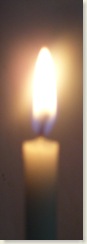
Q.4: Do you see the color distribution between blue and yellow? What gives rise to the two colors? What decides the position of these two colors in the flame?
To verify whether its a feature only 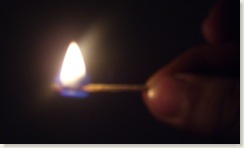
It also shows the similar features, indicating the same Physics governing.
Answers below[can you spot them? :) ] :-
Ans.1. the glow captured in the camera depends on the exposure setting. The molecules are exciting and de-exciting at a rapid rate. The de-excitation is very fast, 10^(-8)sec, but the excitation depends on the temperature in that region. In the second photo, wider region is captured, indicating larger exposure time.
Ans.2.Fluid dynamics of simple laminar flow... Its same to the flow of water when you open it at very slow speeds. This is flow below the Reynolds number. Above Reynolds number, the flow is chaotic, as can be seen in the case of smoke from an incense.
Ans.3.Sphere !? :) that's my guess...
Ans.4.higher temperatures give higher excitation and de-excitation, resulting in blue. Only two colors are seen corresponding to energy levels available. the position shows the temperature profile.
Wednesday, November 26, 2008
Friction - Evil or God !
Everywhere you see, one is attempting to reduce Friction. E.g. the lubricating oils in ball bearings, door hinges. However, have you thought about what would happen if there was no Friction!
Without Friction, you can't even walk on the floor! That's what happens, in rain, if the floor is slippery, you tend to fall down. Why, because the Friction has got reduced. Its a strange thing that the force of Friction, which opposes every motion, is actually supporting the entire mechanism of motion!
Let's say you want to walk. Now suppose you were in Space, then unless someone gave you a push, you wouldn't move from where you are! So when you walk, what you do is you push back on the ground. The only way you can push something is when you have some grip over it. That's Friction. Without Friction, when you attempt to walk, you will actually roll over and fall!
When a wheel moves on the floor, three things can happen: It can slide like a sledge- this happens when your wheels are break locked and there is no rotation of wheel, or It can rotate without any translation, as it happens when a wheel is stuck in a ditch of mud, and any amount of acceleration only gives it rotation, no translation. Third thing which is expected, normal behaviour, is rotation and translation. This can happen only when there is adequate Friction.
What is Friction. On a microscopic level, the smooth looking surface is not a regular plane. There are hills and valleys at atomic level. Whenever two surfaces meet, they form temporary contacts, and molecules of one surface invade in hills and valleys of other surface. They interlock and push each other. So if a top surface is moving forward on a bottom surface, the bottom surface pushes the top one back, and the top surface pulls the bottom one forward.
This is easily seen in case of liquids. The analog of Friction is Viscocity. An Oil is more viscous than water and Honey is more viscous than Oil. In a mixer, when the blade rotates, it carries along with it the layer of liquid next to it, and that layer drags the next layer with it and so on, the subsequent liquids are set in motion. Had there been no Viscocity, you wouldn't be able to stir your coffee!
Without Friction, you can't even walk on the floor! That's what happens, in rain, if the floor is slippery, you tend to fall down. Why, because the Friction has got reduced. Its a strange thing that the force of Friction, which opposes every motion, is actually supporting the entire mechanism of motion!
Let's say you want to walk. Now suppose you were in Space, then unless someone gave you a push, you wouldn't move from where you are! So when you walk, what you do is you push back on the ground. The only way you can push something is when you have some grip over it. That's Friction. Without Friction, when you attempt to walk, you will actually roll over and fall!
When a wheel moves on the floor, three things can happen: It can slide like a sledge- this happens when your wheels are break locked and there is no rotation of wheel, or It can rotate without any translation, as it happens when a wheel is stuck in a ditch of mud, and any amount of acceleration only gives it rotation, no translation. Third thing which is expected, normal behaviour, is rotation and translation. This can happen only when there is adequate Friction.
What is Friction. On a microscopic level, the smooth looking surface is not a regular plane. There are hills and valleys at atomic level. Whenever two surfaces meet, they form temporary contacts, and molecules of one surface invade in hills and valleys of other surface. They interlock and push each other. So if a top surface is moving forward on a bottom surface, the bottom surface pushes the top one back, and the top surface pulls the bottom one forward.
This is easily seen in case of liquids. The analog of Friction is Viscocity. An Oil is more viscous than water and Honey is more viscous than Oil. In a mixer, when the blade rotates, it carries along with it the layer of liquid next to it, and that layer drags the next layer with it and so on, the subsequent liquids are set in motion. Had there been no Viscocity, you wouldn't be able to stir your coffee!
Subscribe to:
Posts (Atom)